Exploring the Significance of Recurring Dreams

b249fce0817df555d7139f60e76f9d49--occult-hermes

This workshop will focus on the extraordinary significance of recurring dreams and how they need to be understood in terms of our psychological wellness and development. Recurring dreams may run in a short series or as continuations of another dream, or in some cases they repeat themselves from childhood to the advanced years of adult life. Recurring dreams may be the direct result of serious traumas or they may reveal creative potentials totally unknown to the dreamer. In this workshop, common recurring dream motifs will be discussed as well as clinical examples in the context of Jungian theory. Exercises to help interpret dreams of this type will be offered. Participants are encouraged to bring in examples of their own to share or reflect on in the workshop.

JUNG, ALCHEMY AND EASTERN HEALING TRADITIONS: Ancient and Modern Practices for Health and Longevity

A wrong functioning of the psyche can do much to injure the body, just as conversely a bodily illness can affect the psyche; for psyche and body are not separate entities but one and the same life. -C. G. Jung

There is no illness that is not at the same time an unsuccessful attempt at a cure. -C. G. Jung

In this course we will explore the major themes of mental and physical health and longevity, trauma and illness, individuation and enlightenment, in light of the evolution of Jung’s synthesis of ideas on alchemy, integration of the shadow, and eastern healing traditions. We will look at recent developments in the West on such topics as PTSD, embodied trauma, intergenerational transmission of trauma, neuroscience, nutritional science, and various methods for nurturing the body through food choices, sleep, exercise.

From the Eastern standpoint, we will examine healing traditions that have been practiced and tested for thousands of years, as Jung put it, “the medical philosophies of a distant past,” such as Taoism, Hatha Yoga, Dream and Sleep Yoga, the Chakras, Tibetan Buddhism, as well as Chinese medicine and acupuncture and the use of meditation and mantras to create a refuge of peace within mind and body. We will look at how much in modern medical research and neuroscience helps verify the efficacy of these practices.

The spiraling complexity, stress, and pressures of modern life have created a vortex of toxicity and contagion that has penetrated into the psyche and body of modern humans. This is evidenced by the spiraling epidemic of modern health problems such as immune disorders, obesity, heart disease, cancer and diabetes, and anxiety, depression, and other mental disorders. The use of anti-depressants has increased 400% in the last 10 years in an attempt to avoid this suffering. By integrating ancient and modern practices, we can integrate trauma and the shadow aspects of body and psyche. We can use these practices to reclaim the energy that was used to dissociate and numb us from our wounds, perpetuate outmoded and pathological defense mechanisms, addictions, and projections, in order to overcome our resistance to lifestyle changes that can heal us. We can then use the recollected energy and “chi” for self-care and creative life force, and inoculate the immune systems of our body and psyche to better resist future infection. By making better conscious choices for bodily nourishment, we are able to create an energetic dimension that supports the higher experiences of the psyche, and by making better conscious choices for our psychic nourishment, we benefit and strengthen the body. In this way we can work to promote excellent health and long life and find our way on the path of individuation and enlightenment.

Unconditional Care of the Self: Solutio and the Alchemical Transformation of Defense Mechanisms and Addictions

“Every form of addiction is bad, no matter whether the narcotic be alcohol, morphine or idealism.” -Jung

“Wind blowing over water disperses it, dissolving it into foam and mist. This suggests that when a man’s vital energy is dammed up within him, gentleness serves to break up and dissolve the blockage” – Richard Wilhelm, The I-Ching, Hexagram 59; Dispersion

Unconditional care for the Self is a process that embodies gentle acceptance of the totality of our self including those parts that we disown and find repugnant.  In this way  we don’t become pathogenic to ourselves and become our own worst enemy to our shadow, our greatest source of growth.  As a result of  not being seen as children, of being disrespected, neglected, criticized, judged and violated, we may have dissociated and imprinted the qualities of the original perpetrators deep in our psyche.  Developing unconditional care is an antidote to self attack and autoimmune reactions within the psyche that block the dissolution of compensatory defenses and addictions and  integration of the shadow .

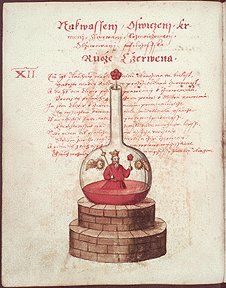
The Alchemical operation ‘Solutio’ turns solid into liquid through dissolution or baptism.  In the classic alchemical treatise, The Splendor Solis, an illustration depicts an old king sitting in the alchemical bath while a man applies a bellows to the fire underneath, to “wash out the murkiness and shade” so the king can be purified and transformed into the “prima materia.”  Achilles, whose well intentioned mother, the nymph Thetis, bathed Achilles in the river Styx as she held him by the heel so that he could become immortal, might have asked, “Mom, what are you doing?”  She might have answered, as Alice Miller said ironically, its “for your own good,” leaving his heel the one vulnerable place left to later magnetize the fatal arrow during the Trojan War.

How can we make the arrow point an inoculation of consciousness?  Often we are shot with the arrow over and over before we get the message that we have magnetized our own rejected primal wounds.  If we can treat that repugnant wound consciously,  uncritical of our failure in battle, even venerate our repugnance, we may be able to re-baptize ourselves and re-experience the essence of our wounds and see the blessing of these symptoms that hitherto have been perceived as enemies.  We no longer throw out the baby with the bathwater.

Richard Wilhelm introduced Chinese Alchemy to Jung  who synthesized the teachings with Western Alchemy creating a more effective psychology.  Jung said of  Wilhelm “he has inoculated us with the living germ of the Chinese spirit.” In this course we will explore a cross inoculation of Eastern and Western Alchemical concepts that promote Solutio, such as myth and dream analysis and active imagination  from the West and the I-Ching, Tibetan Tantric practices such as Dream and Sleep yoga, dark retreats, and the use of Mantra and Meditation from the East.

Creativity and Destruction Dissociation, Chaos, and the Coniunctio in the Pursuit of Bliss

“I say to you, one must yet have chaos in himself in order to give birth to a dancing star.”

Friedrich Nietzsche

Creation and destruction go hand in hand with the alchemical process that Jung illuminated in his life‘s work: “In the end the only events in my life worth telling are those when the imperishable world irrupted into this transitory one….These form the prima materia of my scientific work.  They were the fiery magma out of which the stone that had to be worked was crystallized.”  During the period of his life Jung called “confrontation with the unconscious” he was driven to the edge of total psychic dissociation. But the experience of this madness, this “magma” was essential for him to be able to integrate the shadow and discover the union of the unconscious and conscious; the conjunctio, the goal of alchemy.  This opened him up to a long lived volcanic flow of creative ideas that was to last until his death at the age of 85.  Others smitten with the creative daimon are not so lucky, they drown in it and die young.  Janis Joplin, Jimi Hendrix, Kurt Cobain, and literally dozens of other rock stars, joined “the 27 Club,” all dying at the age of 27 from drug overdoses.  There is something very seductive about stars dying in Dionysian frenzy seeking ecstasy and becoming immortalized as martyrs.  Their addictions did not allow them to listen to their bodies whose pain, if heard, could help set limits. Can we remain tied to the mast of the ship, like brave Ulysses in the Odyssey, “whose naked ears were tortured by the sirens sweetly singing,” (while his crew had their ears plugged with wax) and not be lured into crashing our ship on the rocks, or overdosing on heroin or, like Lance Armstrong, destroying his body and career on steroids? Is getting untied from the mast and being seduced by the sirens a way of avoiding what Thoreau points out that “The mass of men live lives of quiet desperation?” Should we tamper with creativity and genius through psychoanalysis? Virginia Woolf, who feared just that said, “As an experience, madness is terrific I can assure you, and not to be sniffed at; and in its lava I still find most of the things I write about.  It shoots out of one everything shaped, final not in mere driblets, as sanity does.”

Joseph Campbell says “Follow your bliss and the universe will open doors for you where there were only walls.” But what is bliss?  Is it ambrosia, the Grail, or the alchemical elixir and how does one find it? And when it often happens that the doors that the universe opens up contain chaos, dissociation and manic depression and we add those ingredients into the alchemical cauldron in our psyche, do we end up immersed in the bath of Dionysian-Mercurial waters as King and Queen preparing for the coniunctio or, like one rock star with his groupie, in a bath of Dom Perignon high on cocaine. In this course we will examine the lives of people like Jung, Paracelsus, Nietzsche, Van Gogh, Mozart as well as contemporary creatives to learn from their process. We will consider the issue of traumas, unlived lives or partially lived lives and the possibility that past lives may be incubated inside us and influence the seeds of our creative potential. We will explore how the pressures of society, religion, morality and culture effect the creative process and take a look at how Taoism and Tantra can provide a structure to support the transmutation of the forces of Sol and Luna. We will look for alchemical tools to help make transformations that will allow us to value the experience of chaos consciously, as something to be achieved as a result of the conjunctio rather than something to be totally dreaded and avoided. These tools, such as active imagination, dream incubation, divination, and meditation can be used to temper and embody our process.

The Alchemy of Consciousness In and Out of Body An Exploration of Embodiment, Parapsychology, Death and Rebirth

dbcdaa09a4db9821e35a3f77028bcc0f--medieval-art-rosario

Far below I saw the globe of the Earth, bathed in a gloriously blue light…Presumably I too was in my primal form…I felt as though I were floating in space, as though I were safe in the womb of the universe in a tremendous void, but filled with the highest possible feeling of happiness…It is impossible to convey the beauty and intensity of emotion during those visions. They were the most tremendous things I have ever experienced.”   C.G. Jung

Being embodied is an experience of feeling finite in the form of the body.  To be identified with one’s thoughts, and hence “out of the body” and then manage to enter into an embodied state, moves a person back to his or her true essence.”  Nathan Schwartz Salant

It is not coincidence that the first subject of Carl Jung’s collected works was occult phenomena. This was in clear opposition to Freud’s causality driven world view.  When Freud told Jung to “promise never abandon the sexual theory…that we must create a dogma of it…an unshakeable bulwark…against the black tide of mud of occultism.”  These words “alarmed” Jung and ultimately split his relationship with his mentor.

These “so called occult phenomena” involve the concept that consciousness and spirit can exist ‘in’ as well as ‘outside’ the body, and not just limited to the biological function of the brain.  As much as these ideas terrified Freud, they, thankfully, helped propel Jung into a healing crisis, his “confrontation with the unconscious,” with the result that he formulated some of the most revolutionary and practical psychological advances in modern times.  In the process, Jung struggled to understand issues of science and faith, death and rebirth, precognition and karma.  He also found that it was essential to stay grounded and embodied enough so as not to be “torn to pieces” by the intense “emotions wrought up” by this experience.  Jung’s self experiment provides a model for the animation of the individuation process.

Violence, abuse, emotional incest, war, medical procedures, near death experiences, shock, dissociate and displace our consciousness and tend to drive it out of body.  Even our good qualities and talents can send us out of body through inflation.  Especially intense and intrusive energy can cause states of possession that occupy the body stubbornly and dominate and alter perceptions.  In response to the stress, compensatory defense mechanisms, addictions and prescribed medications can fill the gap left by the displaced psyche and prevent us from re-inhabiting our bodies fully in an attempt to protect us.  Paradoxically, the greater the displacement and dissociation, the greater the repetition of the patterns that synergize with the wounding.

If we can become mindfully aware of this displacement, we can turn the reverberating effects of trauma into a healing crisis. Then we can build our psychic and bodily immune response to these revisited patterns and eventually dissolve the imprints in and outside the body enough so that we can re-occupy our bodies safely and thrive.  Paradoxically, to do this, we often need to go “out of body” into a world that can transcend time and space, that often forces an encounter with our mortality in processes more easily identified with the occult or shamanism. These “non-ordinary states” encourage synchronistic occurrences that can help our selves associate consciously to our reactivity and the realization that these seemingly external triggers and patterns are actually self generated.  With this increased orbit of conscious psychic existence we can expand our individuation energy’s connectivity and create opportunities to get clarity about our role and meaning in our lives, fear death less, and live more in the present.

In this course we will examine the alchemical psychodynamics of embodiment, attachment, displacement, the confusion of simultaneous mixed in and out of body states, and collective and religious influences on these states.  We will explore Jung’s struggle with questions about the transformation of psychic energy when the body dies, astral experiences, precognition and reincarnation as well as Nathan Schwartz Salant’s work on fusion states.